
博士,1998,中国科学技术大学
Ph.D., 1998, University of Science and Technology of China
图论与组合及其应用
Graph Theory and Combinatorics and their applications
Ph. D. in Mathematics, University of Science and Technology of China, China (June 1998).
Combinatorics and Graph Theory and their Applications.
1. Spectral Graph Theory. Most important properties of a graph are related to its eigenvalues. However, it is only recently that it has been possible to make this connection precise. New techniques have been developed to control many graph invariants in terms of eigenvalues and eigenfunctions. In particular, this involves a strong two-way interaction between concepts and methods from continuous mathematics and their emerging discrete counterparts. The Neumann eigenvalues are useful for dealing with random walk problems. Thus the eigenvalue lower bounds can be used to bound the rate of convergence of the random walks and polynomial approximation algorithms can be derived for these problems.
2. Extremal Graph Theory. It is one of the most developing branches of Discrete Mathematics. One is interested in the relations between the various graph invariants, such as order, size, connectivity, minimum degree, maximum degree, chromatic number and diameter, and also in the values of these invariants which ensure that the graph has certain properties.
3. Combinatorial Matrix Theory. Combinatorial matrix theory is concerned with the use of matrix theory and linear algebra (for example, the adjacency, Laplacian matrices of a graph and the incidence matrix of a combinatorial design, etc.) in proving combinatorial theorems and describing and classifying combinatorial constructions. It is also concerned with the use of combinatorial ideas and reasoning in the finer analysis of matrices and with intrinsic combinatorial properties of matrix arrays. While combinatorial matrix theory has emerged as a vital area of research over the last few decades, research in combinatorial matrix proceeds in a number of diverse directions simultaneously.
4. Random Graphs and Complex Networks. Inspired by empirical studies of networked systems such as the Internet, social networks, and biological networks, researchers have in recent years developed a variety of techniques and models to help us understand or predict the behavior of these systems. Here we review developments in this ?eld, including such concepts as the small-world effect, degree distributions, clustering, network correlations, random graph models, models of network growth and preferential attachment, and dynamical processes taking place on networks. The study of networks, in the form of mathematical graph theory, is one of the fundamental pillars of discrete mathematics. First, it aims to build and highlight statistical properties, such as path lengths and degree distributions, that characterize the structure and behavior of networked systems, and to suggest appropriate ways to measure these properties. Second, it aims to create models of networks that can help us to understand the meaning of these properties—how they came to be as they are, and how they interact with one another. Third, it aims to predict what the behavior of networked systems will be on the basis of measured structural properties and the local rules governing individual vertices.
5. Combinatorics and Graph Theory’s Applications. There are many applications in Combinatorics and Graph Theory. (1) DNA structure in biology, including studying graph structures of DNA , RNA etc and describing structure of DNA and RNA with their graph propertires, such as degree, spectrum, etc. (2) Machine learning and data mining in computer science, in particular, consider the problem of constructing a representational for data lying on a lower dimensional manifold embedded in a high dimensional space. (3). Applicationsin Chemistry , such as Huckel’s theory, electron energy in a molecule, winner index, etc.
Honors and Awards:
Second class award for outstanding achievement in science and technology from Anhui Province. Project: Research on combinatorial matrix theory (with Jiong-Sheng Li, Yao-Ping Hou, Yong-Liang Pan and Jian-Hua Yin, 2003).
Third class award for outstanding achievement in science and technology from State Education Ministry of China. Project: Nonnegative matrices and represent theory (with Shang-Jun Yang, Xian-Neng Du, 1999)
Second class award for outstanding achievement in science and technology from higher education of committee of Anhui Province. Project: Nonnegative matrices and their applications (with Shang-Jun Yang, 1997).
AcademicServices:
1. Editors of the journal "Theory and Applications of Graphs" from Jan. 2014.
2. Editors of the journal "Discrete Mathematics,Algorithms and Applications" from Jan. 2014.
3. 中国运筹学会图论组合分会副理事长 2015-2023
4. 中国工业与应用数学协会图论组合分会常务理事2015-2023
5. 中国数学会组合数学与图论学会协会理事 2010-2022.
6. 中国高等教育学会教育数学专业委员会 副理事长,2024--
1. International Cooperation Department of the Ministry of Science and Technology. Project: Research on Topological Indices of Molecular Networks. No.4-3. Jan. 2025-Dec. 2026. Principal Investigator.
2. The National Natural Science Foundation of China. Project: Eigenvalues and Eigenspaces of Graphs with its Applications. No. 12371354, Jan, 2024-Dec.2027, Principal Investigator.
3. The National Natural Science Foundation of China. Project: Spectral Extremal GraphTheory and Applications. No. 11971131, Jan. 2020-Dec. 2023, Principal Investigator.
4. Registration For Inter-Governmental Science and Technological CooperationProposal: Chinese- Montenegro. Project: Researchon Chemical Graph Theory. No.3-12. Nov. 2018-Oct. 2020. Principal Investiagtor.
5. The National Natural Science Foundation of China for International Cooperation and Exchange. Project: SpectralGraph Theory, Completely Positive Matrices and Co-Positive Matrices. No. 11561141001,Oct. 2015—Sep. 2018. Principal Investigator.
6. The National Natural Science Foundation ofChina for the State Key Program. Project: Random tree, random graph andstochastic process, No. 11531001, Jan.2016—Dec.2020. Co- PrincipalInvestigator.
7. The National Natural Science Foundation ofChina. Project: Spectral Graph Theory forNetwork Science No. 11271256, Jan. 2013—Dec. 21016, Principal Investigator.
8. Innovation Program of Shanghai MunicipalEducation Commission. Project: Eigenvaluesof Graphs and Its Applications, No.14ZZ016, Jan. 2014—Dec. 2016, PrincipalInvestigator.
9. Specialized Research Fund for the DoctoralProgram of Higher Education, Project: SpectralGraph Theory and Application To Complex Networks, No.20130073110075, Principal Investigator.
10. The National Natural Science Foundation ofChina. Project: Spectral Analysis ofgraphs and complex networks, No. 10971137, Jan. 2010—Dec. 21012, Principal Investigator.
11. The Grant of Science and TechnologyCommission of Shanghai Municipality (STCSM), No. 09XD1402500, Jan. 2009—Dec. 2011, Co-PrincipalInvestigator.
12. The National Basic Research Program (973)of China, No. 2006CB805900, Jan. 2006—Dec.2010, Co-Principal Investigator.
13. The National High Technology Research andDevelopment Program (863) of China, No. 2006AA11Z209, Jan. 2006—Dec. 2008, Co-Principal Investigator.
14. The Natural Science Foundation of Shanghai,No.06ZR14049, Sep. 2006 — Aug.2008, Co-Principal Investigator.
15. The National Natural Science Foundation ofChina for the State Key Program. Project: Random graphs and complex networks, No: 10531070, Jan. 2006—Dec. 2009,Co-Principal Investigator
16. .The National Natural Science Foundation ofChina. Project: Combinatorial matrixtheory and related topics, No: 10371075, Jan. 2004—Dec. 2006, PrincipalInvestigator.
17. The Project Sponsored by the ScientificResearch Foundation for the Returned Overseas Chinese Scholars, State EducationMinistry. Project: Combinatorial matrixtheory, Jan. 2003—Dec. 2004, Principal Investigator.
Selected Invited Talks :
1. Title: SomeSpectral Turan-type Results of Graphs, theoccasion of his 62 birthday International Conference on Number Theory and GraphTheory, June. 27-29, 2019, University of Mysore, India.
2. Title: Chemical Indices of Graphs with Given DegreeSequences, The Second MontenegrinSymposium on Graphs, Informatics and Algebra, MESIGMA 2019, Budva,Montenegro, October 11-15, 2019.
3. Title: Equitablepartition theorem of tensors and spectrum of generalized power hypergraphs, 22nd Conference of the International LinearAlgebra Society-ILAS 2019 Rio de Janeiro, Brazil, July 8-12, 2019.
4. Title: The TuranNumbers for Linear Forests,Structural GraphTheory and Graph ColoringTSIMF, Sanya,April 29 to May 3, 2019.
5. Title: ChemicalIndices of Graphs with Given Degree Sequences, Mathematical Chemistry at the 2018 Spring Southeastern sectionalmeeting of AMS, April 14-15, 2018 Vanderbilt University, Nashville, TN, USA.
6. Title: Someresults in spectral (hyper)graph theory, SIAMConference on Applied Linear Algebra May 4-8, 2018, Hong Kong BaptistUniversity, Hong Kong.
7. Title: The TuranNumbers for Linear Forests, 2017EURO-ORSC-ECCO International Conference on Combinatorial Optimization, May3-6, 2017,
8. Title: On Thespectral Turan-Type Results of graphs, TheSixth International Conference on Matrix Analysis and Applications June 15-18, 2017, Duy Tan University, Danang Vietnam.
9. Title: Someresults of spectral extremal graphs, 3rdPacific Rim Mathematical Association Congress (PRIMA2017),August 14-18,2017,Oaxaca, MEXICO.
10. Title: CP rankof Graphs, Copositivity and CompletelyPositivity, October 29 -November 4, Mathematisches ForschungsinstitutOberwolfach, Germany
11. Title: TheSignless Laplacian Spectral Radius of Graphs Forbidden Linear Forests, 2017 Korea-China International Conference onMatrix Theory with Applications, December 14-17, 2017 Sungkyunkwan University,South Korea.
12. Title: SpectralTuran-Type Theorems of graphs, The 29th Regional Conference of The JangjeonMathematical Society, November11-13, 2016. , Dague University, South Korea.
13. Title: Extremal GraphTheory for Degree Sequences,The SixthInternational Congress of ChineseMathematicians (ICCM),July 14–19, 2013,in National TaiwanUniversity, Taiwan.
14. Title:TheDirichlet eigenvalues of graphs and the Faber-Krahn Inequality, TheEleventh Japan-Korea Workshop on Algebraand Combinatorics, January24-25,2013,Kyushu University,Fukuoka City, Japan.
15. Title: Merris’Problems and Doubly Stochastic Graph Matrice, The 4th International Conference on Matrix Analysis andApplications2013,July 2-5, 2013,Konya, Turkey.
SELECTED PAPERS AND BOOKS
There are over 200 papers which have been published in the referenced journal and two chapters in the books and one book.
1. Xuetong Li, Xiao-Dong Zhang, Multi-view clustering integrating anchor attribute and structural information, Neurocomputing 630 (2025) 129689
2. Zeng Jiasheng; Zhang, Xiao-Dong A note on the Bollobás-Nikiforov conjecture. Linear Algebra Appl. 710 (2025), 230-242. 05C50 (05C35)
3. Zhao, Kai; Zhang, Xiao-Dong A localized approach for Turán number of long cycles. J. Graph Theory 108 (2025), no. 3, 582-607. 05C38 (05C35)
4. Zhang, Peng-Li; Zhang, Xiao-Dong Bounds for the incidence Q-spectral radius of uniform hypergraphs. Appl. Math. Comput. 490 (2025), Paper No. 129201, 12 pp. 05C50 (05C65 15A18)
5. Zhao, Kai; Zhang, Xiao-Dong Localized version of hypergraph Erdos-Gallai theorem. Discrete Math. 348 (2025), no. 1, Paper No. 114293, 13 pp. 05C65 (05C38)
6. Hu, Qitong; Zhang, Xiao-Dong Key motifs searching in complex dynamical systems. Phys. D 469 (2024), Paper No. 134318, 11 pp. 37E99
7. Wang, Yuzhenni; Yu, Xingxing; Zhang, Xiao-Dong A class of trees determined by their chromatic symmetric functions. Discrete Math. 347 (2024), no. 9, Paper No. 114096, 11 pp. 05C31 (05C05 05C15)
8. Zhang, Peng-Li; Feng, Li-Hua; Liu, Wei-Jun; Zhang, Xiao-Dong The Q-index and connectivity of graphs. J. Oper. Res. Soc. China 12 (2024), no. 2, 505-519. 05C50 (05C40)
9. Chen, Ming-Zhu; Liu, A-Ming; Zhang, Xiao-Dong The signless Laplacian spectral radius of graphs without intersecting odd cycles. Electron. J. Linear Algebra 40 (2024), 370-381. 05C50 (05C35)
10. Zhang, Shan; Chen, Xun; Ma, Zhen-Wei; Zhang, Xiao-Dong; Chen, Ya-Hong The minimum Wiener index of unicyclic graphs with maximum degree. Appl. Math. Comput. 470 (2024), Paper No. 128581, 9 pp. 05C09
11. Hu, Qitong; Zhang, Xiao-Dong Fundamental patterns of signal propagation in complex networks. Chaos 34 (2024), no. 1, Paper No. 013149, 16 pp.
12. Yuan, Long-Tu; Zhang, Xiao-Dong Extremal graphs for even linear forests in bipartite graphs. Discuss. Math. Graph Theory 44 (2024), no. 1, 5–16.
13. Jin, Ya-Lei; Zhang, Jie; Zhang, Xiao-Dong Upper bounds of spectral radius of symmetric matrices and graphs. Linear Algebra Appl. 682 (2024), 152–163.
14. Chen, Ming-Zhu; Liu, A-Ming; Zhang, Xiao-Dong The spectral radius of minor-free graphs. European J. Combin. 118 (2024), Paper No. 103875, 15 pp.
15. Wang, Yuzhenni; Zhang, Xiao-Dong A note on median eigenvalues of subcubic graphs. Discrete Appl. Math. 342 (2024), 138–141. 05C50
16. Chen, Ming-Zhu; Li, Shuchao; Li, Zhao-Ming; Yu, Yuantian; Zhang, Xiao-Dong An Aα-spectral Erdős-Sós theorem. Electron. J. Combin. 30 (2023), no. 3, Paper No. 3.34, 15 pp.
17. Chen, Ming-Zhu; Wang, Ning; Yuan, Long-Tu; Zhang, Xiao-Dong The bipartite Turán number and spectral extremum for linear forests. Linear Algebra Appl. 676 (2023), 150–173.
18. Chen, Yi-Ze; Li, Xin; Zhang, Xiao-Dong The extremal average distance of cubic graphs. J. Graph Theory 103 (2023), no. 4, 713–739.
19. Wang, Yuzhenni; Zhang, Xiao-Dong On weighted spectral radius of unraveled balls and normalized Laplacian eigenvalues. Discrete Math. 345 (2022), no. 12, Paper No. 113173, 9 pp.
20. Yang, Yu; Liu, Hongbo; Wang, Hua; Zhang, Xiao-Dong; Philip Chen, C. L. On enumerating algorithms of novel multiple leaf-distance granular regular α-subtrees of trees. Inform. and Comput. 289 (2022), part A, Paper No. 104942, 22 pp.
20. Zhang, Jie; Gray, Daniel; Wang, Hua; Zhang, Xiao-Dong On the combinatorics of derangements and related permutations. Appl. Math. Comput. 431 (2022), Paper No. 127341, 10 pp.
21. Zhang, Fuzhen; Zhang, Xiao-Dong Comparison of the upper bounds for the extreme points of the polytopes of line-stochastic tensors. Southeast Asian Bull. Math. 46 (2022), no. 5, 681–689.
22. Yuan, Long-Tu; Zhang, Xiao-Dong. Turán numbers for disjoint paths, 98 (2021), no. 3, 499–524.
23. Jin, Ya-Lei; Gu, Rui; Zhang, Xiao-Dong The distance energy of clique trees. Linear Algebra Appl. 615 (2021), 1–10.
24. Chen, Ming-Zhu; Liu, A-Ming; Zhang, Xiao-Dong. On the spectral radius of graphs without a star forest. Discrete Math. 344 (2021), no. 4, Paper No. 112269, 12 pp.
25. Zhu, Xiaomin; Zhang, Xiao-Dong The hitting time of random walk on unicyclic graphs. Linear Multilinear Algebra 69 (2021), no. 4, 573–592.
26. Cioabă, Sebastian; Feng, Lihua; Tait, Michael; Zhang, Xiao-Dong The maximum spectral radius of graphs without friendship subgraphs. Electron. J. Combin. 27 (2020), no. 4, Paper No. 4.22, 19 pp.
27. Berman, Abraham; Shaked-Monderer, Naomi; Singh, Ranveer; Zhang, Xiao-Dong Complete multipartite graphs that are determined, up to switching, by their Seidel spectrum. Linear Algebra Appl. 564 (2019), 58–71.
28. Zhang, Xiu-Mei; Sun, Yu-Qin; Wang, Hua; Zhang, Xiao-Dong On the ABC index of connected graphs with given degree sequences. J. Math. Chem. 56 (2018), no. 2, 568–582
29. Yang, Jin-Xuan; Zhang, Xiao-Dong A spectral method to detect community structure based on distance modularity matrix. Internat. J. Modern Phys. B 31 (2017), no. 20, 1750129, 17 pp.
30. Yuan, Long-Tu; Zhang, Xiao-Dong The Turán number of disjoint copies of paths. Discrete Math. 340 (2017), no. 2, 132–139
31. Zhang, Xiu-Mei; Yang, Yu; Wang, Hua; Zhang, Xiao-Dong Maximum atom-bond connectivity index with given graph parameters. Discrete Appl. Math. 215 (2016), 208–217.
32. Jin, Ya-Lei; Yeh, Yeong-Nan; Zhang, Xiao-Dong Laplacian coefficient, matching polynomial and incidence energy of trees with described maximum degree. J. Comb. Optim. 31 (2016), no. 3, 1345–1372.
33. Jin, Ya-Lei; Zhang, Xiao-Dong On the spectral radius of simple digraphs with prescribed number of arcs. Discrete Math. 338 (2015), no. 9, 1555–1564.
34. Lu, M.; Wan, D.; Wang, L.-P.; Zhang, X.-D. Algebraic Cayley graphs over finite fields. Finite Fields Appl. 28 (2014), 43–56.
35. Zhang, Xiu-Mei; Zhang, Xiao-Dong; Gray, Daniel; Wang, Hua The number of subtrees of trees with given degree sequence. J. Graph Theory 73 (2013), no. 3, 280–295
36. Deng, Yun-Ping; Zhang, Xiao-Dong Automorphism groups of the pancake graphs. Inform. Process. Lett. 112 (2012), no. 7, 264–266.
37. Lee, Moon Ho; Zhang, Xiao-Dong; Song, Wei; Xia, Xiang-Gen Fast reciprocal jacket transform with many parameters. IEEE Trans. Circuits Syst. I. Regul. Pap. 59 (2012), no. 7, 1472–1481
38. Zhang Xiao-Dong, Vertex degrees and doubly stochastic graph matrices, Journal of Graph Theory, 66 (2011) 104–114.
39. Ma, Zhihao; Yuan, Weigang; Bao, Minli; Zhang, Xiao-Dong A new entanglement measure: D-concurrence. Quantum Inf. Comput. 11 (2011), no. 1-2, 70–78
40. Deng, Yun-Ping; Zhang, Xiao-Dong Automorphism group of the derangement graphs. Electron. J. Combin. 18 (2011), no. 1, Paper 198, 8 pp.
41. Gu, Lei; Zhang, Xiao-Dong; Zhou, Qing Consensus and synchronization problems on small-world networks. J. Math. Phys. 51 (2010), no. 8, 082701, 9 pp.
42. Zhang Xiao-Dong, Xiang Qi-Yuan, Xu Li-Qun, and Pan Rong-Ying, The Wiener index of trees with given degree sequences. MATCH Commun. Math. Comput. Chem. 60 (2008), no. 2, 623–644.
43. Zhang Xiao-Dong, The Laplacian spectral radii of trees with degree sequences, Discrete mathematics, 308(2008), 3143-3150.
44. Lee, Moon Ho; Zhang, Xiao-Dong Fast block center weighted Hadamard transform. IEEE Trans. Circuits Syst. I. Regul. Pap. 54 (2007), no. 12, 2741–2745
45. Zhang, Xiao-Dong; Bylka, Stanislaw Disjoint triangles of a cubic line graph. Graphs Combin. 20 (2004), no. 2, 275–280.
46. Zhang Xiao-Dong, The equality cases for the inequalities of Fischer, Oppenheim, and Ando for general M-matrices.
47. Zhang Xiao-Dong, Graphs with fourth Laplacian eigenvalue less than two. European J. Combin. 24 (2003), no. 6, 617–630.
48. Martínez, Servet; San Martín, Jaime; Zhang, Xiao-Dong A new class of inverse M-matrices of tree-like type. SIAM J. Matrix Anal. Appl. 24 (2003), no. 4, 1136–1148.
49. Hwang, Suk-Geun; Kim, Ik-Pyo; Kim, Si-Ju; Zhang, Xiao-Dong Tight sign-central matrices. Linear Algebra Appl. 371 (2003), 225–240
50. Berman, Abraham; Zhang, Xiao-Dong; On the spectral radius of graphs with cut vertices. J. Combin. Theory Ser. B 83 (2001), no. 2, 233–240.
51. Li, Jiong-Sheng; Zhang, Xiao-Dong On the Laplacian eigenvalues of a graph. Linear Algebra Appl. 285 (1998), no. 1-3, 305–307.
52. Li, Jiong-Sheng; Zhang, Xiao-Dong A new upper bound for eigenvalues of the Laplacian matrix of a graph. Linear Algebra Appl. 265 (1997), 93–100.
53. Zhang, Xiao Dong; Yang, Shang Jun An improvement of Hadamard's inequality for totally nonnegative matrices. SIAM J. Matrix Anal. Appl. 14 (1993), no. 3, 705–711.
Books and chapters
1. The Laplacian eigenvalues of grpah: a survey, Chapter 6 in Linear Algebra Research Advance, PP 201—228. Gerald D. Ling etc, Nova Science Publishers, INC., 2007.
2. Spectral Analysis; Encyclopedia of Social Network Analysis and Mining, Reda Alhajj and Jon Rokne eds., Springer Science+Business Media New York, ISBN: 978-1-4614-6169-2 (Print) 978-1-4614-6170-8 (Online)
3. Li Qiao and Zhang Xiao-Dong, Ten Lectures for Matrix Theory, Press of University of Science and Technology of China, 2015.
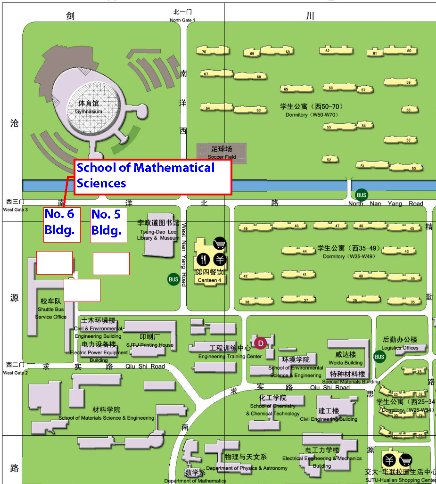
Address:
800 Dongchuan RD Shanghai, Minhang District
Shanghai 200240,China
COPYRIGHT 2016 © SCHOOL OF MATHEMATICAL SCIENCES, SHANGHAI JIAO TONG UNIVERSITY 大阳城娱乐手机版登录 ©版权所有
公开信息按发布时间滚动。阅读「大阳城娱乐手机版登录」后,可返回栏目或查看相邻条目。
建议先扫读标题与摘要,再进入全文。同栏目条目通常按更新顺序排列。
若从搜索引擎进入,可先确认当前栏目名称,再按需打开相关阅读。
教师 FACULTY · 博士后 POSTDOCS · 主页 · 师资队伍 faculty